Wednesday, April 27, 2011

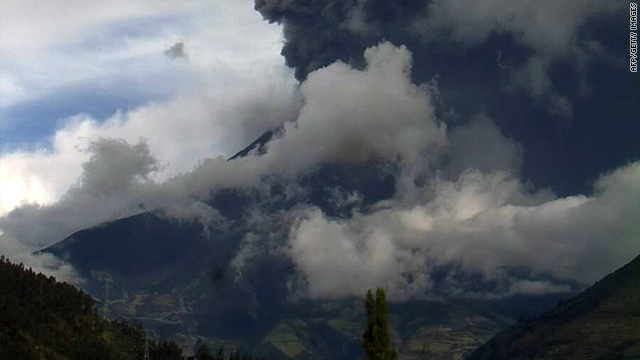
Residents evacuate as volcano spit ashes in Ecuador


(CNN) -- Authorities in Ecuador closed schools and evacuated residents in areas near a volcano Tuesday after ashes spewing from its crater fell on homes and farms, state media reported.
Ashes from Tungurahua -- which means "throat of fire" in the native Quechua language -- rose more than 7 kilometers (4 miles) into the air Tuesday, the government news agency said.


Authorities issued an alert as monitors detected six eruptions, ranging from moderate to large, and a significant ash cloud Tuesday, state media said. "According to our observations, damages to crops, pastures and small effects to the health of people are already evident," the country's geophysics institute said.
Officials first detected increased activity in the volcano April 20, with monitors observing regular small eruptions of ash and gas.
The glacier-capped, 16,478-foot volcano has erupted periodically since 1999, when increased activity led to the temporary evacuation of the city of Banos at the foot of the volcano.
Tungurahua erupted in December, sending ash and lava spewing nearly a mile into the sky.
Major eruptions also occurred in August 2006 and February 2008, according to the government's emergency management agency.
Before the recent activity, the last major eruption was between 1916 and 1918. Relatively minor activity continued until 1925, the Smithsonian Institution said on its volcano website.
The volcano is 140 kilometers (86 miles) south of Quito, Ecuador's capital.

Tuesday, April 26, 2011

Libya: UN team to start probe of human rights abuses


A Libyan boy is treated after being wounded by shelling in Misrata - 25 April 2011  
 
There are many reports Libyan forces have shelled the rebel-held city of Misrata indiscriminately

A UN team is due to arrive in Tripoli to investigate allegations of human rights violations in Libya since the start of the conflict in February.
The team was appointed by the UN Human Rights Council following the Libyan government's crackdown on protesters.
The government has said it will co-operate with the inquiry.
The three investigators say they will look at all alleged abuses, including those the government says have been committed by rebels or Nato forces.
The original mandate - to examine human rights violations allegedly committed by the forces of Libyan leader Col Muammar Gaddafi - remains the priority, says the BBC's Imogen Foulkes in Geneva, where the UN Human Rights Council is based.
There have been reliable reports of enforced disappearances, torture and even killing of protesters, says our correspondent.
The UN human rights commissioner, Navi Pillay, said in late February that what was happening in Libya "may amount to crimes against humanity".

More recently, there have been reports that Col Gaddafi's forces trying to retake Misrata from rebels are indiscriminately shelling the city.
On Tuesday, three people were reportedly killed as missiles slammed into the city's port, a lifeline for those seeking to escape to the rebel stronghold of Benghazi.
Misrata has been besieged by government forces for two months, leaving parts of the city with neither electricity nor water.
Continued sniper fire, street clashes and shelling have prevented people from venturing outside their homes to get food and medicine.
Human rights groups say more than 1,000 people have been killed in the fighting and many more have been wounded. Ships have been ferrying the injured to hospitals in Benghazi and bringing in humanitarian aid.
Libya's government denies it has been indiscriminately shelling civilian areas.
Misrata is the last major rebel-held city in western Libya and the fighting for it has been fierce.
The UN investigators are to present their findings to the Human Rights Council in June. But their work could be overtaken by other moves, says our Geneva correspondent.
The UN Security Council has asked the International Criminal Court to investigate Libya on possible charges of war crimes.

Japan's irradiated waters: How worried should we be?

By Ken Buesseler, Special to CNN
April 26, 2011 -- Updated 1359 GMT (2159 HKT)
  • Tsunami caused the largest accidental release of radiation the oceans have ever seen
  • There is still too much that that is unknown about the effects, says Ken Buesseler
  • We don't yet know where contaminants are going or how fast they are spreading
  • Buesseler: Internationally supported field studies in the Pacific are needed immediately
tzleft.buesseler_ken.fukushima.jpgEditor's note: Ken Buesseler is a marine radiochemist and senior scientist at the Woods Hole Oceanographic Institution.

(CNN) -- Twenty-five years ago, I was a Ph.D. student here in Woods Hole, Massachusetts, studying the fate of fallout in the North Atlantic from nuclear weapons testing, when an explosion and fire at the Chernobyl nuclear plant released large quantities of radioactive materials into the surrounding environment. My colleagues and I immediately joined other scientists tracking these radioactive contaminants, which in my case focused on the Black Sea, the closest ocean to the accident site.
A quarter-century later, I can still measure fallout from Chernobyl in the Black Sea, though fortunately at levels that are safe for swimming, consuming seafood and, if you could remove the salt, even drinking. I never thought I'd see another release anywhere near the magnitude of Chernobyl.
As we now know, the tsunami that hit Japan on March 11 caused immediate, widespread devastation on land and failure of cooling systems at the Fukushima Daiichi nuclear power facility. The resulting partial meltdowns, hydrogen explosions and fires at Fukushima released radioactive contaminants into the air and water. In addition, runoff from the attempts to cool the reactors with seawater and fresh water further contaminated the ocean around Fukushima.
Data released by Japanese scientists show cesium-137 concentrations in the waters immediately adjacent to the reactors at levels more than 1 million times higher than previously existed and 10 to 100 times higher in the waters off Japan than values measured in the Black Sea after Chernobyl. For the oceans, this is the largest accidental release of radiation we have ever seen.
But what do these high values mean for ocean life and human health? What will it mean 25 years from now?
We know the ocean has the ability to mix and dilute even these alarmingly high concentrations of contaminants. Indeed, just 15 miles offshore the levels of some contaminants, including cesium-137, with its relatively long 30-year half-life, are already 100 to 1,000 times lower than waters near the reactors, and thus pose little direct hazard for human exposure. We also know that over the short-term, isotopes such as iodine-131, which has an eight-day half-life and has been found in milk and spinach, will decay to insignificant levels.
But there is still too much that we don't know. We still have not measured the full complement of radionuclides released to the oceans, including the highly toxic plutonium. We have not mapped where contaminants are going and how fast they are spreading, so we can't confirm how well our models are predicting dispersion and dilution of these substances.
The groundwater around Fukushima and sediments in the seafloor nearby will likely remain contaminated for decades to come, yet no radionuclide data exist from these sources. There are also large gaps in our knowledge of how marine life assimilates radioactive contaminants, how the process may vary depending on different life stages, or how contaminants will transfer up the food chain to fish and other marine animals. This information will be essential for short-term assessments of threats to transportation, health, fisheries and ocean ecosystems, and for informing nuclear industry regulatory policies and oceanography for decades to come.
Early observations are key to understanding what has occurred. The Japanese have begun ocean field work to fill in some of these gaps in our knowledge, but this is a bigger job than any single country, agency or lab can take on.
If we are to fully grasp the extent of those effects and help mitigate them, the international community must support efforts to immediately undertake comprehensive field studies in the Pacific Ocean near Japan. Follow-up work will be needed for years and decades to come before we are able to say with any certainty that we understand the fate of these radionuclides in the ocean and the effect they have had on the marine environment.
After 25 years, we are just beginning to grasp Chernobyl's legacy. Now Fukushima presents similar challenges, but with the added complication of leaving its imprint on the ocean, a complex system that is vital to human health and the world economy.
Perhaps somewhere a young scientist's career is being shaped by the events unfolding right now in Japan. I certainly hope there is more than one, because the questions we face are many, and they will not be answered soon. Or easily.

Chernobyl nuclear disaster: Ukraine marks anniversary

Ukraine is marking the 25th anniversary of the world's worst nuclear accident - at the Chernobyl power plant.
An explosion at one of the plant's reactors sent a plume of radiation across Europe in 1986, harming or killing possibly thousands of people.
Ukrainian President Viktor Yanukovych and his Russian counterpart, Dmitry Medvedev, are visiting the site for a memorial ceremony.
The anniversary comes amid renewed global protest over nuclear power.
The debate has been reinvigorated by the threat of radiation from Japan's crippled Fukushima plant in the aftermath of a devastating earthquake and tsunami.
New shield Early on Tuesday, Mr Yanukovych attended a candle-lighting service led by Russian Orthodox Patriarch Kirill in the Ukrainian capital, Kiev.
"The world had not known a catastrophe in peaceful times that could compare to what happened in Chernobyl," Patriarch Kirill said.

Start Quote

The world had not known a catastrophe in peaceful times that could compare to what happened in Chernobyl”
End Quote Patriarch Kirill
A bell sounded at 0123 (2223 GMT Monday), the time of the blast, and tolled 25 times.
It was on 26 April 1986 that Number Four reactor at Chernobyl, which was then in the Soviet Union, exploded.
The accident forced the evacuation of hundreds of thousands of people from their homes in Ukraine, western Russia and Belarus.
Soviet officials held off reporting the accident for several days.
There is still a 30km (19-mile) exclusion zone around the plant.
Soviet engineers encased the damaged reactor in a temporary concrete casing to limit the radiation but a new shield is needed.
A donors conference in Kiev, Ukraine, last week raised 550m euros (£486m; $798m) of the 740m euros needed to build a new shelter and a storage facility for spent fuel.
 
'Tell the truth'
 
Anti-nuclear protest on Pont de l'Europe over Rhine between France and Germany - 25 April 2011
The Chernobyl anniversary comes less than two months after the Fukushima nuclear plant in Japan was badly damaged by an earthquake and tsunami, renewing concerns about the safety of nuclear power generation.
The operators of the Fukushima plant, Tokyo Electric Power Co, have also come under fire for not quickly disclosing information on radiation leaks from the plant.
Mr Medvedev said there must be greater transparency in nuclear emergencies.
"I think that our modern states must see the main lesson of what happened at Chernobyl and the most recent Japanese tragedy as the necessity to tell people the truth," he told survivors of the clean-up effort at a meeting in the Kremlin.
On Monday, thousands of people in France and Germany staged protests calling for an end to nuclear power.
Marches were held on several river bridges between France and Germany over the Rhine while there were further protests at German nuclear plants.
Meanwhile in India, security has been tightened around Jaitapur, where protesters are planning to march on the site of a planned six-reactor nuclear power plant.

High radiation levels detected at Fukushima grounds a month after explosions

photoThe Fukushima No. 1 nuclear power plant (Provided by Air Photo Service)
Editor's note: We will update our earthquake news as frequently as possible on AJW's Facebook page: http://www.facebook.com/AJW.Asahi. Please check the latest developments in this disaster. From Toshio Jo, managing editor, International Division, The Asahi Shimbun.

* * *


High levels of radiation were detected on the grounds of the Fukushima No. 1 nuclear power plant one month after hydrogen explosions spewed radioactive materials, according to Tokyo Electric Power Co.
The findings were shown in a map depicting radiation levels that TEPCO released for the first time on April 24.
Radiation levels in the air around the No. 1 and No. 3 reactor buildings were especially high, mainly because the hydrogen explosions damaged the buildings and spread radioactive materials.
The air in an area to the northwest of the No. 3 reactor building had radiation levels of up to 70 millisieverts per hour. That building was damaged by a hydrogen explosion on March 14, three days after the Great East Japan Earthquake and tsunami crippled the plant.
TEPCO first compiled the radiation level map on March 22 and has periodically updated it. The map is used to monitor radiation exposure of workers at the Fukushima plant and prepare new work plans for the plant grounds.
Workers check radiation levels in the air every seven to 10 days or before any work procedure starts.
If unusually high radiation levels are detected, further testing of rubble in the area is conducted to determine the cause of the high levels.
Radiation levels as high as 130 millisieverts per hour were confirmed around the No. 1 and No. 3 reactor buildings in late March.
Because radiation decreases with the passage of time, subsequent testing found lower levels.
But if the level of 70 millisieverts per hour continues to the northwest of the No. 3 reactor building, a worker who remains in that area for four hours will have been exposed to more than the upper limit of 250 millisieverts established for individuals engaged in work at the Fukushima plant.
Workers exposed to that total level of radiation will not be allowed to work in the area.
On March 20, concrete rubble found west of the No. 3 reactor building had radiation levels of 900 millisieverts per hour. Even after that rubble was removed, radiation levels in the air measured between 10 and 30 millisieverts per hour.
Another pile of rubble emitting radiation levels of 300 millisieverts per hour was found near the No. 3 reactor building.
Almost all of the contaminated rubble was concrete from the No. 1 reactor building that was damaged in a hydrogen explosion on March 12 as well as from the No. 3 reactor building, hit by an explosion there on March 14.
According to calculations by the Nuclear Safety Commission of Japan, the equivalent of 190,000 terabecquerels of radioactive iodine had been spewed from the reactor buildings by March 15. A terabecquerel is equivalent to 1 trillion becquerels.
That high level meant the Fukushima plant accident had already reached the worst level 7 on the International Nuclear and Radiological Event Scale, matching the assessment given to the 1986 Chernobyl nuclear disaster.
A pipe installed to move radiation-contaminated water from the trench of the No. 2 reactor to a central waste processing facility was found to have radiation levels of 160 millisieverts per hour on its surface.
Areas within the plant ground at a distance from the reactor buildings were also found to have radiation levels that exceeded 1 millisievert per hour.
High radiation levels in the air were found even after rubble in the area was removed.
The rubble, removed by remote-controlled heavy equipment, has been placed in 50 containers and moved to a temporary storage area within the plant grounds. A considerable amount of rubble remains, however.
While TEPCO officials continue to remove the rubble to allow for easier work within the plant, one official said the radiation would not have a major effect on work because the contamination has already been figured into the road map for work procedures.

(This article was written by Keisuke Katori and Hidenori Tsuboya.)
Deadly Turkish plane crash probed

Wreck of Turkish Airlines plane at Schiphol
The plane crashed short of the runway where it had been due to land
Investigations are continuing into what caused a Turkish Airlines plane to crash at Amsterdam's Schiphol airport, killing nine people and injuring 86.
The plane, en route from Istanbul with 127 passengers and seven crew, crashed short of the runway on Wednesday.
Three of those killed were members of the crew. Dutch officials said most of the passengers on board were Turkish.
Relatives of some of those killed have arrived in Amsterdam on a special Turkish Airlines flight from Turkey.
On Thursday investigators took detailed photographs of the wreckage in a bid to uncover what happened in the flight's final moments.

That so many people were able to walk out was truly remarkable
Fred Sanders
Dutch Safety Board

The flight data and voice recorders from the aircraft have been sent to Paris, where experts have specialist equipment to analyse them.
The Boeing 737-800 aircraft came down at 1031 local time (0931 GMT), several hundred yards short of the runway, about three hours after it left Istanbul's Ataturk Airport.
It broke into three pieces on impact. Most of those on board survived, although many were hurt.
Fire did not break out and within a minute those capable of walking began staggering out of the ruptured plane.
"It is a real wreck," said Fred Sanders, spokesman for the Dutch Safety Board.
"That so many people were able to walk out was truly remarkable. Some have called it a miracle," he added.
Turkish Transport Minister Binali Yildirim also described the low death toll as a miraculous.

SCHIPHOL ACCIDENTS
27 October 2005: A fire at the airport's detention centre killed 11 people and injured 15
4 April 1994: Three people were killed and 13 seriously injured when a KLM flight carrying 24 people crashed on landing
4 October 1992: An El Al Boeing 747 cargo plane crashed into an apartment block after takeoff, killing 43 people

"The fact that the plane landed on a soft surface and that there was no fire helped keep the number of fatalities low," he said.
Mr Sanders said the investigation at the scene of the crash would take a few days, after which the wreckage would be removed. A preliminary report could be released in weeks, he added.
Dutch health officials said on Thursday that 25 passengers had suffered severe injuries and that another six were in a critical condition. They are being treated at 11 hospitals in the area.
The Turkish transport ministry said 78 Turkish nationals and 56 people of other nationalities had been on board the plane.
Candan Karlitekin, head of Turkish Airlines' board of directors, said records showed the plane had been properly maintained. The pilot, a former Turkish air force officer, was highly experienced, he added.
'Suddenly descended'
Survivor Jihad Alariachi said there had been no warning from the cockpit to brace for landing before the ground loomed up through the mist.

Map: schiphol airport

"We braked really hard, but that's normal in a landing. Then the nose went up. And then we bounced... with the nose aloft," she said.
Another passenger aboard the plane, Kerem Uzel, told Turkish news channel NTV that the plane's landing had been announced when they were at an altitude of 600m (2,000ft).
"We suddenly descended a great distance as if the plane fell into turbulence. The plane's tail hit the ground... It slid from the side of the motorway into the field."
Witnesses on the ground described seeing the plane appear to glide through the air, having lost all propulsion, before hitting the ground and breaking into three pieces.
Some passengers were able to climb out of the plane before rescue workers arrived.
The last crash involving a Turkish Airlines plane was in 2003, when at least 65 people died in an accident in eastern Turkey.
Schiphol airport has six runways and one major passenger terminal. In 2007, it handled 47 million passengers, ranking fifth in Europe.

Saturday, April 2, 2011

Harga Blackberry April 2011 Baru dan Bekas

harga blackberry april 2011Harga blackberry 2011 berikut sesuai dengan kisaran harga counter, akan tetapi untuk mendapatkan harga akurat silahkan anda cek ditoko masing-masing daerah anda. Karena setiap daerah akan beda hasilnya. Harga blackberry ini merupakan harga rekapan dari harga blackberry maret lalu yang masih tayang pada bulan april 2011. jadi untuk mendapatkan update terbaru harga blackberry april 2011 simak terus artikel disini.

Harga Blackberry »